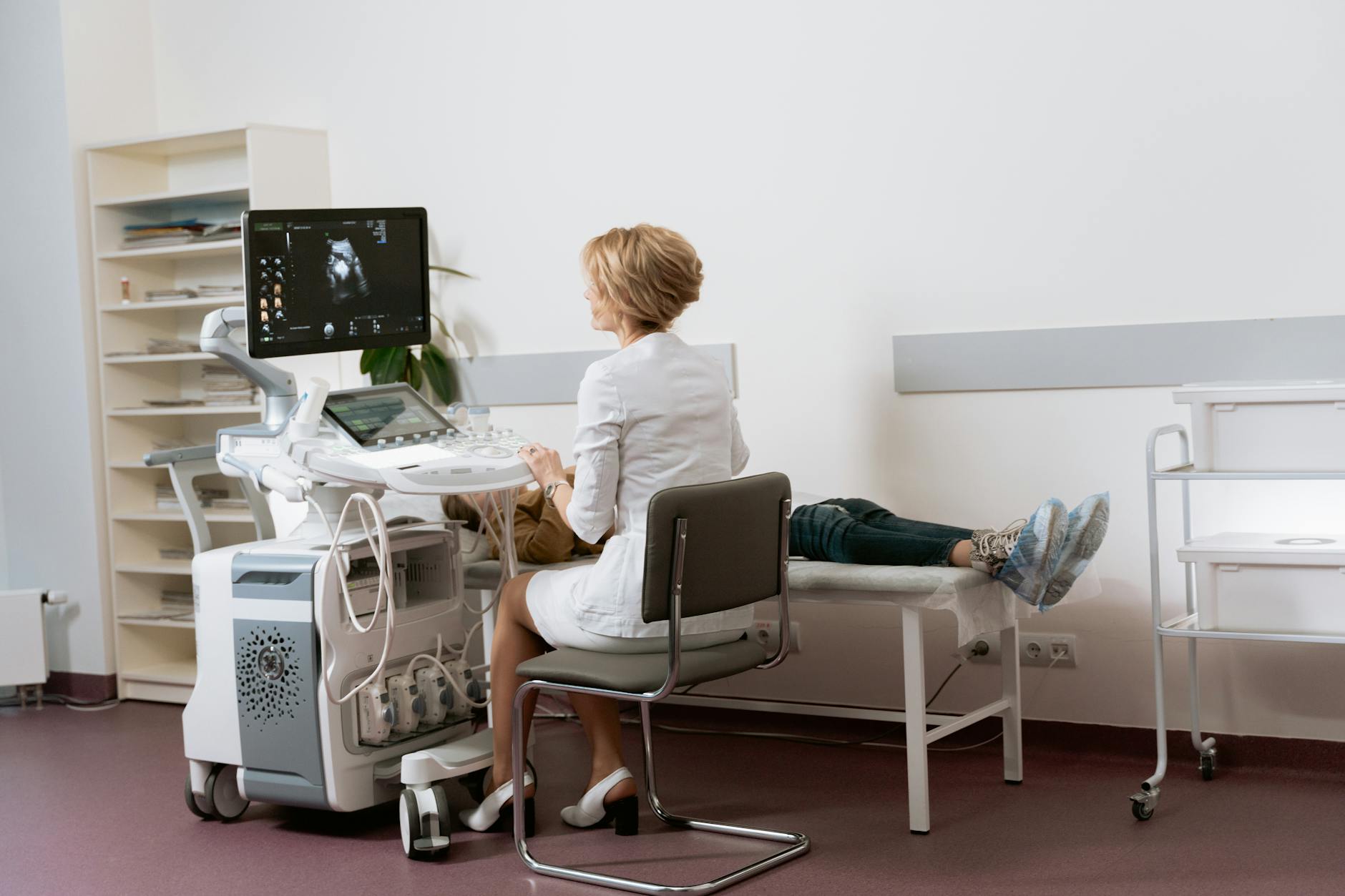
"sentence": "Imagine you're interpreting ai ultrasound images in a rural emergency clinic hours from the nearest hospital." The doctor suspects a problem with your heart, but there's no specialist on hand to operate or read an ultrasound machine. This scenario — common in many parts of the world — is exactly the kind of problem that AI-powered ultrasound interpretation is being built to solve.
Ultrasound imaging has long been one of medicine's most useful tools: it's non-invasive, doesn't use radiation, and can reveal what's happening inside the body in real time. But reading those fuzzy, flickering images well has always required years of specialist training. AI is beginning to change that equation, and the implications stretch from emergency rooms to rural clinics to your routine cardiology appointment.
What Is AI Ultrasound Interpretation?
At its core, AI ultrasound interpretation means using machine learning software to analyze the images produced by an ultrasound scan — often in real time, as the scan is happening. Instead of a radiologist or cardiologist reviewing images after the fact, the AI watches alongside, looking for patterns that indicate normal or abnormal anatomy.
These systems are trained on enormous libraries of ultrasound images that have already been labeled by expert clinicians. Over thousands or millions of examples, the AI learns what a healthy heart looks like versus one with a structural problem, or what a normal liver scan looks like compared to one showing disease. When it encounters a new image, it applies those learned patterns to flag potential issues or guide the person performing the scan.
This is meaningfully different from older computer-assisted tools that simply enhanced image contrast or measured distances. Modern AI systems can interpret what they're seeing — not just display it more clearly.
💼 Career Opportunities
Two Jobs AI Is Taking On: Acquisition and Interpretation
One useful way to understand where AI fits is to separate two distinct challenges in ultrasound: acquiring a good image (getting the probe in the right position, at the right angle), and interpreting that image once you have it. AI is now doing meaningful work on both fronts.
Guiding the Person Holding the Probe
Getting a diagnostic-quality ultrasound image is harder than it looks. The probe must be positioned precisely, and small adjustments can make the difference between a clear, useful image and a blurry, misleading one. Traditionally, this skill took years to develop.
The FDA has cleared several AI-assisted ultrasound tools, including Caption AI from Caption Health, which guides users to acquire diagnostic-quality cardiac ultrasound images. Caption AI works like a real-time coach: as someone holds the ultrasound probe against a patient's chest, the software analyzes what it sees and gives on-screen guidance — nudge left, tilt the probe, hold steady — until the image meets a quality threshold. This means someone without years of sonography training can still produce an image good enough to be clinically useful.
Interpreting What the Scan Shows
Once you have a good image, the AI's second job is to make sense of it. This is where the pattern recognition comes in — identifying structures, measuring them, and flagging anything that looks abnormal.
A clear example of this is in cardiac care. One of the most important numbers a cardiologist wants to know is a patient's ejection fraction — the percentage of blood the heart pumps out with each beat. A healthy heart typically ejects more than half the blood in its left chamber; a significantly lower number can indicate heart failure. Calculating ejection fraction from an ultrasound used to require a specialist to carefully trace the outline of the heart chamber in multiple frames — a time-consuming, skill-dependent task.
GE HealthCare's Venue ultrasound system includes an AI feature called Auto EF that automatically calculates ejection fraction (a key measure of heart function) from ultrasound scans. The AI identifies the chamber walls, traces them automatically, and produces a measurement in seconds. This doesn't eliminate the need for clinical judgment — a physician still reviews the result — but it dramatically reduces the time and expertise required to get to that number.
Why This Matters: Reaching People Who Don't Have Access to Specialists
The global shortage of radiologists and sonographers is a real and serious problem. In many countries, there simply aren't enough trained specialists to read all the imaging that's needed. Patients wait longer, conditions are caught later, and in rural or under-resourced settings, some imaging simply doesn't happen at all.
AI-assisted ultrasound directly addresses this gap by extending the capabilities of non-specialist clinicians — general practitioners, nurses, paramedics, or emergency physicians — who are often the only healthcare workers available.
Point-of-care ultrasound (POCUS) devices combined with AI guidance have been shown to enable non-specialist clinicians to capture and interpret diagnostic-quality images in emergency and rural settings. Point-of-care ultrasound (POCUS) refers to performing an ultrasound scan right where the patient is — at the bedside, in the field, or in a small clinic — rather than sending them to a dedicated imaging department. When you add AI guidance to a portable POCUS device, you create a tool that a non-expert can actually use to get reliable, actionable results.
Think of it like GPS navigation: a good GPS doesn't make you a professional driver, but it does let someone who knows how to drive get to an unfamiliar destination accurately. AI-guided ultrasound is similar — it doesn't replace clinical knowledge, but it fills in the specialized imaging expertise that's otherwise missing.
How These AI Systems Actually Learn
Understanding how these systems are trained helps explain both their power and their limits. Most AI ultrasound tools use a branch of machine learning called deep learning, which involves neural networks — layers of mathematical operations loosely inspired by how the brain processes information.
These networks are fed enormous datasets of labeled ultrasound images: thousands of scans where an expert has already identified the heart chambers, marked where a tumor is, or noted that the image quality is insufficient. The network adjusts its internal parameters over and over until it reliably reproduces those expert judgments on images it hasn't seen before.
The quality of that training data matters enormously. An AI trained mostly on images from one type of patient population or one brand of machine may not perform as well in different contexts. This is why clinical validation — rigorously testing the system on diverse, real-world patients — is so important before these tools reach clinical practice, and why regulatory review by bodies like the FDA matters.
What AI Can and Can't Do (Yet)
It's worth being honest about the current state of things. AI ultrasound tools are genuinely useful and are already deployed in real clinical settings, but they are not autonomous diagnosticians. They assist — they flag, measure, and guide — but human clinicians remain responsible for the final interpretation and any decisions that follow.
There are also categories of findings where AI performs better or worse. Structured, well-defined measurements like ejection fraction (where there's a clear, numerical answer) are more tractable for current AI than nuanced findings that require integrating clinical context, patient history, and subtle visual cues that might not be captured in a single scan.
Image quality also remains a challenge. Ultrasound images are naturally variable — affected by the patient's body type, the probe position, the machine settings, and even how much the patient is breathing. AI systems need to handle this variability reliably, and the best current tools are designed to flag when image quality is too low to interpret confidently.
What This Means for Patients
For most people reading this, the practical takeaway is encouraging. AI-assisted ultrasound is making diagnostic imaging more accessible and, in specific tasks like measuring heart function, more consistent. If you live in an area with limited specialist access, this technology is most likely to directly benefit you. If you're already seeing cardiologists and radiologists at well-resourced hospitals, you may encounter AI tools working quietly in the background — automating measurements, flagging images for review, or speeding up report turnaround.
The goal isn't to replace the clinician who understands your full medical picture. It's to make sure that the imaging part of their job is done accurately and quickly — and that more patients can access it in the first place.
The Bigger Picture
AI ultrasound interpretation is one piece of a much broader shift happening across medical imaging. The same fundamental approach — training neural networks on expert-labeled data to recognize patterns — is being applied to X-rays, CT scans, MRIs, and pathology slides. Ultrasound is in some ways a particularly interesting frontier because the images are harder to read (more variable, more operator-dependent) and because portable devices make point-of-care use genuinely practical.
Getting from a promising AI model to a tool that's safe and useful in real clinical settings takes significant validation work and regulatory review. The tools that have cleared that bar — like the cardiac AI systems already in use — represent what's possible when that process is done carefully. As more data becomes available and techniques improve, the range of conditions AI can reliably detect from ultrasound is likely to grow.
For now, the combination of portable hardware, AI guidance, and real-time interpretation is already doing something that would have seemed remarkable not long ago: allowing a non-specialist in a remote clinic to produce and act on a cardiac ultrasound with meaningful confidence. That's a genuine step forward for patients who would otherwise have had no access at all.
Sources
Every factual claim in this article was independently verified against the following sources:
- FDA Clears Artificial Intelligence to Guide User for Optimal Cardiac Ultrasound Imaging | Imaging Technology News — itnonline.com
- Artificial Intelligence-Enabled Point-of-Care Echocardiography: Bringing Precision Imaging to the Bedside - PMC — pmc.ncbi.nlm.nih.gov
- GE HealthCare Showcases Latest AI-Enhanced Cardiology Solutions to Enable Real-Time Cardiac Imaging and Assessments at the Point of Care at ESC 2024 | GE HealthCare — investor.gehealthcare.com