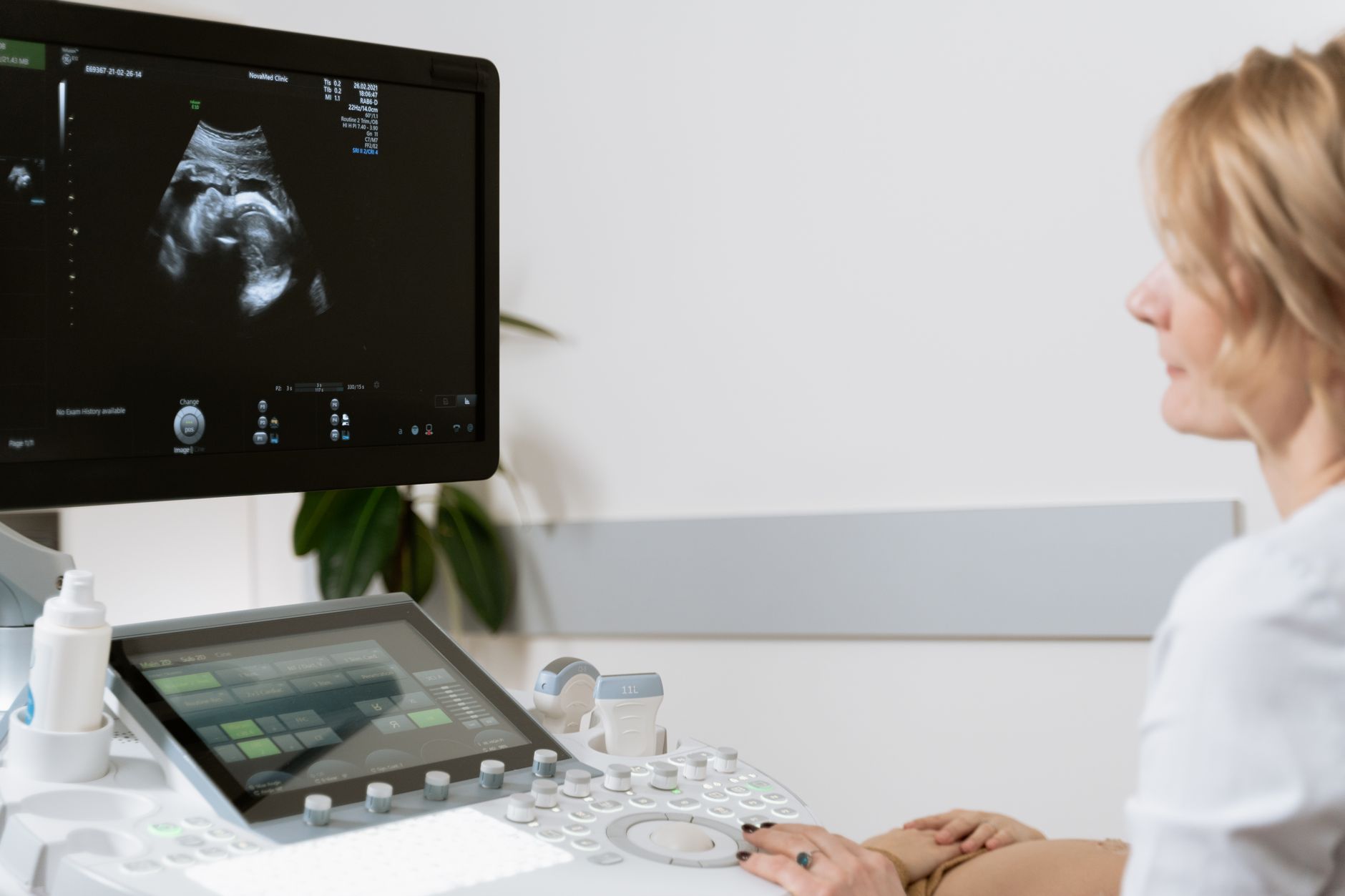
If you've performed prenatal ultrasound for any length of time, you know how much rides on accurate measurements. A few millimeters' difference in a head circumference calliper placement can shift a gestational age estimate, change a growth percentile, or trigger a clinical decision. Now, artificial intelligence systems are being trained to perform those same measurements automatically — and the implications reach far beyond saving a few seconds in the scan room.
What Is Fetal Biometry, and Why Does It Matter?
Fetal biometry involves measuring specific anatomical landmarks — including head circumference, abdominal circumference, and femur length — to estimate gestational age and fetal weight during ultrasound exams. These numbers are the foundation of obstetric ultrasound. They tell the clinician whether the fetus is growing on track, whether delivery dates are correct, and whether there may be growth restriction or macrosomia (larger-than-normal size) that needs closer monitoring.
Each of those measurements requires the sonographer to identify the right anatomical plane, freeze the image at the right moment, and place callipers precisely on the correct landmarks. Get the plane wrong — tilt the transducer slightly off-axis on a biparietal diameter, for instance — and the measurement is unreliable before the callipers even touch the screen. This is a skill built over many training hours, and it varies from practitioner to practitioner.
The Variability Problem AI Is Trying to Solve
Here is the core challenge that motivates a lot of this research: two experienced sonographers scanning the same patient don't always get the same numbers. Automated fetal biometry AI tools have been shown to reduce inter-observer variability — the measurement differences between two human sonographers examining the same scan — which is a known source of diagnostic inconsistency in prenatal care.
Inter-observer variability isn't a sign of incompetence — it's a structural feature of any measurement task that involves human judgment under real-world conditions. Transducer angle, image gain settings, the fetal position on that particular day, and even fatigue all introduce small differences. Across a large population, those differences add up. Babies near a clinical threshold — for growth restriction, for example — may be classified differently depending on who scans them and when.
💼 Career Opportunities
An AI system, once trained, applies the same decision logic every time. It doesn't get tired at the end of a long list. That consistency is precisely what makes automation attractive for biometry specifically, where the measurement itself is the output rather than just a step toward a diagnosis.
How These AI Systems Are Actually Trained
Understanding the training process helps you understand both the power and the limits of these tools — and it's genuinely interesting from a technical standpoint.
Learning From Labelled Images
Most fetal biometry AI systems are trained using supervised machine learning. That means a large dataset of ultrasound images is first labelled by human experts — experienced sonographers or maternal-fetal medicine specialists who mark the correct anatomical landmarks and place reference callipers. These labelled images become the training data: the machine learns by trying to reproduce what the experts did, getting feedback on where it went wrong, and adjusting its internal parameters over millions of iterations.
The quality and diversity of that training dataset matters enormously. A model trained only on images from high-end machines in well-resourced hospitals may struggle when deployed on older equipment or in populations with different body habitus distributions. Researchers working on global-health applications specifically try to include images from the settings where the tool will eventually be used.
Segmentation: Finding the Boundaries
For measurements like head circumference or abdominal circumference, the AI needs to do more than find a single point — it needs to trace the entire outline of a structure. This is called image segmentation, and it involves the model assigning a label to each pixel in the image: "this pixel is inside the fetal head," "this pixel is outside it." Once the boundary is identified, the circumference can be calculated mathematically from that outline.
Deep learning architectures — particularly a type called a convolutional neural network, which is designed to detect spatial patterns in images — have proven well-suited to this task. The network learns which combinations of brightness, texture, and shape correspond to, say, the outer table of the fetal skull at the correct axial plane.
Plane Recognition: Is This Even the Right View?
Measuring the right structure in the wrong plane gives a wrong answer. A critical layer in many automated biometry systems is therefore a plane-recognition component: before measuring anything, the AI first classifies whether the image it's looking at is actually a standard plane suitable for that measurement. If the image doesn't meet quality criteria, the system can flag it rather than generate a spurious number. This is one of the harder problems, because it requires the model to have learned what a "correct" plane looks like across a wide range of fetal positions and image qualities.
AI-Assisted Guidance: Helping Less-Specialized Operators Acquire Better Images
Automated measurement is only one piece of the puzzle. A machine can't measure a structure it can't see clearly, and obtaining diagnostic-quality fetal images requires skill that takes time to develop. This is where AI-assisted guidance tools enter the picture.
Companies including Sonio and Caption Health have developed AI-assisted ultrasound guidance tools aimed at enabling less-specialized operators to acquire and interpret diagnostic-quality fetal images. The idea is to give the operator real-time feedback — essentially, the AI watches what's on screen and tells the user whether they're getting closer to the standard plane, which way to move the transducer, and when the image quality is sufficient to measure. Instead of requiring years of training before someone can perform a useful scan, these systems attempt to compress that learning curve by making the probe guidance more explicit.
This doesn't replace sonographer training — experienced practitioners still perform better, catch more, and understand context in ways AI cannot. But it opens up a different possibility: task-sharing, where a community health worker or general practitioner can perform a basic biometry scan in a setting where no trained sonographer is available, with the AI acting as a scaffold for image acquisition and measurement.
Why This Matters Most in Underserved Regions
In high-resource settings, fetal biometry is performed routinely by trained sonographers with regular access to high-quality equipment and specialist oversight. The AI story here is mostly about efficiency and consistency — valuable, but not transformative.
The more profound impact may come elsewhere. In many low- and middle-income countries, prenatal ultrasound is either unavailable or inconsistently available. There simply aren't enough trained sonographers relative to the population, equipment is limited, and patients in rural areas may have no access to a specialist at all. Complications like fetal growth restriction — a major contributor to perinatal mortality — go undetected because there's no infrastructure to detect them.
Automated biometry, combined with AI-guided image acquisition, changes the math on what's required to deliver basic prenatal surveillance. If a tool can guide a less-specialized operator to acquire usable images and then measure them reliably without expert intervention, a single trained clinician can potentially supervise or audit scans performed across a much wider geographic area. Telemedicine infrastructure — where images are transmitted for remote review — becomes more viable when the images themselves meet a minimum quality standard enforced by the AI.
None of this erases the underlying need for better healthcare infrastructure, training, and resources. But it potentially allows the system to do more with what it currently has while that infrastructure is being built.
What Sonographers Should Understand About These Tools
If you work in a facility where automated biometry tools are being introduced — or if you're advising on their adoption — a few things are worth keeping clearly in mind.
AI Measures What It's Shown, Not What You Know
An AI biometry system will measure the structure it identifies in the image in front of it. If the image quality is poor, the plane is non-standard, or the fetal position introduces ambiguity, the system can still generate a number — and that number may be wrong. The ability to recognize when a measurement is unreliable is currently one of the more important things human sonographers bring to the process that AI systems are still working to replicate. Understanding this limitation is important for anyone who audits or reviews AI-generated measurements.
Reduced Variability Is Not the Same as Perfect Accuracy
These systems reduce inter-observer variability — the spread of results between different operators — but consistency and accuracy are different things. A consistently biased measurement is still a biased measurement. Validation against known gestational ages and against outcomes, not just against other measurements, is the real test of whether a tool is clinically trustworthy.
The Training Data Defines the Tool's Population
A model trained on one population may not perform equally well on another. When a biometry AI tool is introduced in a new clinical setting, understanding what populations and equipment types it was validated on is directly relevant to how much you should trust its outputs in your specific context.
The Bigger Picture
Fetal biometry is, in some ways, an ideal first domain for clinical AI in ultrasound: the task is well-defined, the correct answers are measurable, the clinical stakes are high enough to matter, and the volume of cases is large enough to train and validate models rigorously. Progress here is also building the foundational techniques — segmentation, plane recognition, image quality assessment — that will apply to many other ultrasound applications.
For sonographers, the honest framing is probably this: these tools are becoming part of the workflow, and understanding how they work — what they actually do, where they're reliable, and where they're not — is now part of professional literacy in this field. The goal isn't automation for its own sake. It's making the measurement as reliable as possible, as widely as possible, for the patients who most need it.
Sources
Every factual claim in this article was independently verified against the following sources: