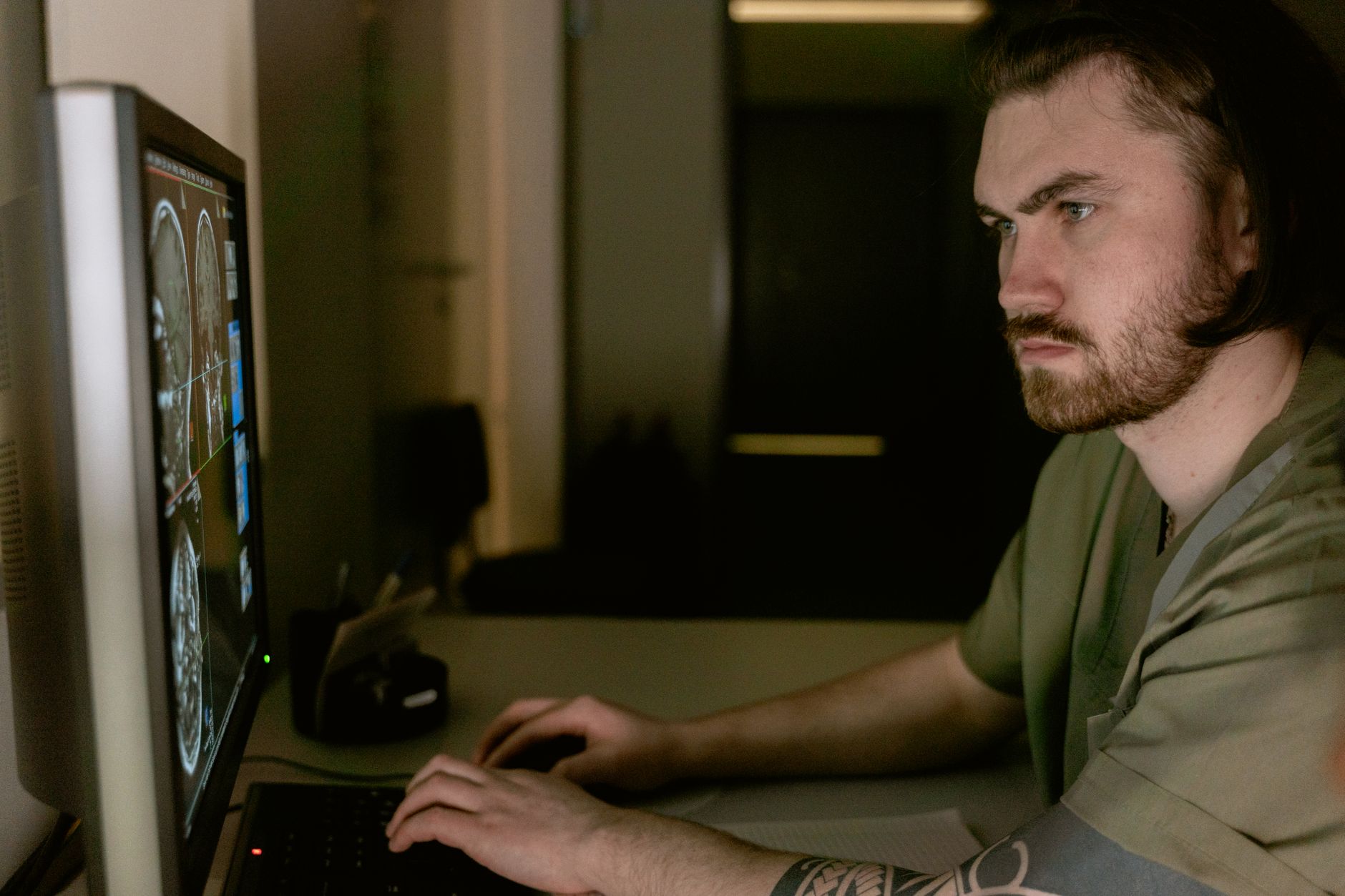
Picture a busy radiology reading room on a Tuesday afternoon. A radiologist has already reviewed 200 scans since morning, and the worklist keeps growing. By the time she reaches scan number 201, her eyes are sharp but her brain is tired — and a subtle 6-millimeter density in a mammogram sits quietly at the edge of normal. This is not a failure of skill. It is a predictable consequence of volume, time pressure, and human cognitive limits. It is also exactly the kind of moment that artificial intelligence is being designed to help with.
AI-assisted cancer detection is one of the fastest-moving areas in medical imaging right now. Understanding how these systems are built, what they actually do, and where their real value lies will help you work alongside them more effectively — and more critically.
Why Radiology Is Especially Suited for AI
Radiology is, at its core, a pattern-recognition discipline. A radiologist looks at an image and asks: does this pixel arrangement represent normal tissue, or does something here deviate from what healthy anatomy looks like? That question — "does this pattern match what I've learned to recognize as abnormal?" — turns out to be something computers can be trained to answer as well.
What makes radiology particularly amenable to AI is that the output is already digital. CT scans, MRIs, mammograms, and chest X-rays exist as numerical data — grids of pixel values — that a computer can ingest directly. There is no need to translate a spoken sentence or interpret a handwritten note. The raw material AI needs is already in a format machines understand.
The Building Blocks: How AI Learns to See
Convolutional Neural Networks: The Engine Under the Hood
Convolutional neural networks (CNNs) are the primary deep learning architecture used in medical image analysis, processing pixel patterns across layers to identify abnormal tissue signatures. It is worth pausing on what that actually means.
💼 Career Opportunities
A CNN does not look at an image the way a radiologist does. It does not have intuition, anatomical knowledge, or clinical context. Instead, it processes an image through a series of mathematical filters — called layers — each of which learns to detect increasingly complex patterns. The first layers might respond to simple edges or brightness gradients. Deeper layers combine those signals to recognize shapes, textures, and ultimately, the complex patterns associated with malignant tissue.
The word "convolutional" refers to the mathematical operation these filters perform: they slide across the image, region by region, looking for specific features at every location. This is what allows a CNN to find a suspicious nodule whether it appears in the upper-left or lower-right corner of a scan — it is checking everywhere, systematically, without fatigue.
Training: Learning from Millions of Examples
A CNN does not arrive knowing what cancer looks like. It learns from examples — and learning requires enormous quantities of labeled data. AI models for radiology are trained on datasets containing tens of thousands to millions of annotated imaging studies, where expert radiologists have labeled regions of interest.
Here is how that process works in practice. A team of radiologists reviews thousands of scans and marks findings: "this is a malignant nodule," "this is benign," "this area is normal." Those labels become the ground truth that the AI tries to reproduce. During training, the model makes a prediction on an image, compares its output to the radiologist's label, measures how wrong it was, and then adjusts its internal parameters slightly to do better next time. Repeat this process millions of times across a large dataset, and the model gradually develops a robust internal representation of what cancer looks like in pixels.
The quality and size of the training data matters enormously. A model trained on a narrow dataset — say, scans from a single institution with a specific scanner brand — may not generalize well when deployed on equipment or patient populations it has never seen. This is one of the central engineering challenges in the field.
The Fatigue Problem: Why AI Works Best as a Partner
One of the most honest arguments for AI assistance is not that machines are smarter than radiologists — it is that machines do not get tired. Radiologists in high-volume settings may read hundreds of images per day, with studies showing diagnostic accuracy declining as reader fatigue increases across a shift.
This is not unique to radiology. Human performance on sustained attention tasks degrades predictably with time and volume. The problem is that in radiology, a moment of inattention is not just inefficiency — it can mean a missed cancer diagnosis, a delayed treatment, and real harm to a patient. An AI system running as a second reader does not degrade over an eight-hour shift. Its 200th analysis is as thorough as its first.
The practical model most commonly discussed is AI as a "concurrent second reader" — flagging findings for the radiologist to review rather than replacing the radiologist's judgment. The radiologist retains final authority. The AI catches what fatigue or volume might otherwise let slip through.
What AI Has Actually Demonstrated: The Mammography Example
One of the most widely cited demonstrations of AI capability in cancer detection comes from breast imaging. Google DeepMind developed an AI system for mammography screening that reduced false negatives by 9.4% compared to a single radiologist, published in Nature in 2020.
A false negative in mammography means a cancer was present but not detected — arguably the most consequential type of error in screening. A 9.4% reduction in missed cancers, compared to a single reader, is clinically meaningful. It represents real patients whose cancers would have gone undetected until they became harder to treat.
It is important to understand what this result tells us and what it does not. It shows that an AI system, on a specific dataset, outperformed a single radiologist on the false-negative rate. It does not mean AI is ready to read mammograms autonomously, nor that every AI system will achieve this in every clinical setting. But it establishes that the technology can provide genuine diagnostic value, not just theoretical promise.
The Regulatory Landscape: Where Things Stand
The United States Food and Drug Administration evaluates AI-assisted imaging tools as medical devices. The FDA had cleared over 700 AI-enabled medical devices as of 2023, with radiology accounting for the largest share of those clearances. That radiology dominates this list reflects both how mature the field has become and how urgent the clinical need is.
FDA clearance does not mean a tool is perfect — it means the agency has evaluated evidence that the tool is safe and effective for its stated purpose. As a practicing sonographer or radiology professional, understanding the regulatory status of any AI tool your department uses is part of informed practice. A cleared device has been reviewed; an experimental or research-use tool has not.
Building and Validating AI Closer to Home
One practical concern with commercially developed AI tools is whether they will perform on your patients, with your equipment, in your specific clinical environment. A model trained primarily on data from academic medical centers may behave differently at a community hospital with a different patient demographic or a different scanner protocol.
This is part of the motivation behind institutional AI development programs. The ACR (American College of Radiology) launched its AI-LAB platform to allow radiologists to build and validate AI models using their own institutional imaging data. The logic is straightforward: a model trained and validated on data from your institution is more likely to reflect the real-world conditions your radiologists work in. This also gives institutions the ability to evaluate commercial AI tools against their own patient population before deploying them in clinical care.
For technologists and sonographers, this points to an important role you may increasingly play: understanding how the data you acquire — image quality, protocol adherence, patient positioning — directly affects the quality of what an AI model can learn from or analyze.
What AI Cannot Do (Yet, and Perhaps Ever)
It would be misleading to present AI as a solution without being honest about its limits. Current AI systems in radiology are narrow: they are trained to do one specific task (detect lung nodules, flag suspicious breast densities, identify intracranial bleeds) and they do not generalize beyond it. They do not bring clinical context — they cannot know that a patient is immunocompromised, or that a finding on today's scan needs to be interpreted against a scan from three years ago that looks almost identical.
AI systems can also fail in ways that are hard to predict. They may perform well on the kinds of images they were trained on and poorly on edge cases — unusual presentations, rare pathologies, imaging artifacts — precisely the situations where an experienced radiologist's judgment is most valuable. Overreliance on AI output without critical human review is a genuine risk, not a hypothetical one.
The productive framing is collaboration: AI excels at systematic, tireless pattern-matching across high volumes of data. Radiologists excel at integrating clinical context, reasoning about uncertainty, and exercising judgment in novel situations. The combination is more capable than either alone.
What This Means for Your Practice
As a diagnostic medical sonographer or ultrasound technologist, you may not be the one reading AI-flagged findings — but you are producing the images those systems analyze. A few practical takeaways are worth carrying from this overview.
Image quality is the foundation. AI models learn from and analyze pixel data. Poor acquisition — motion artifact, suboptimal gain settings, inadequate coverage of a region — degrades what the AI can assess, just as it degrades what a radiologist can assess. Your technical standards matter as much in an AI-assisted workflow as in a traditional one.
Understanding the tool matters too. When an AI system flags something in your department, knowing what it was designed to detect, how it was validated, and what its known failure modes are helps the whole team interpret its output appropriately. These systems are powerful tools, not oracles.
Finally, the clinical problem AI is trying to address — missed findings under high-volume conditions — is real, documented, and worth taking seriously. AI second-reader systems are not a criticism of radiologists. They are an acknowledgment that volume, time pressure, and fatigue affect human performance, and that designing better systems means building tools that support humans rather than assuming humans will always perform at their best.
The Bigger Picture
The integration of AI into radiology is not a distant future scenario. Hundreds of cleared tools are already in clinical use, and the field is advancing rapidly. For imaging professionals at every level, the most useful posture is informed engagement: understanding what these systems do, how they were built, where they add value, and where they can mislead.
The AI in your department is not there to replace your expertise. It is there because catching cancer early saves lives, and every tool that helps — whether it is a better transducer, a refined protocol, or a machine learning model that never blinks — is worth understanding well.
Sources
Every factual claim in this article was independently verified against the following sources:
- International evaluation of an AI system for breast cancer screening | Nature — nature.com
- FDA has now cleared 700 AI healthcare algorithms, more than 76% in radiology — radiologybusiness.com
- A Systematic Review of Fatigue in Radiology: Is It a Problem? | AJR — ajronline.org
- Foundation models for radiology—the position of the AI for Health Imaging (AI4HI) network - PMC — pmc.ncbi.nlm.nih.gov
- ACR launches ACR AI-LAB™ | Applied Radiology — appliedradiology.com
- A typical convolutional neural network (CNN) Architecture for Medical... | Download Scientific Diagram — researchgate.net