Imagine your doctor needs to know how well your heart is pumping. The traditional answer involves a specialist, a gel-covered probe pressed against your chest, and years of trained eyes interpreting a fuzzy, flickering video of your beating heart. It's skilled work — and like all skilled work, it takes time, costs money, and isn't always available when or where you need it. Now artificial intelligence is learning to do a significant part of that job, and doing it with remarkable accuracy. Here's how AI echocardiogram analysis actually works, and why it matters for the future of cardiac care.
What Is an Echocardiogram?
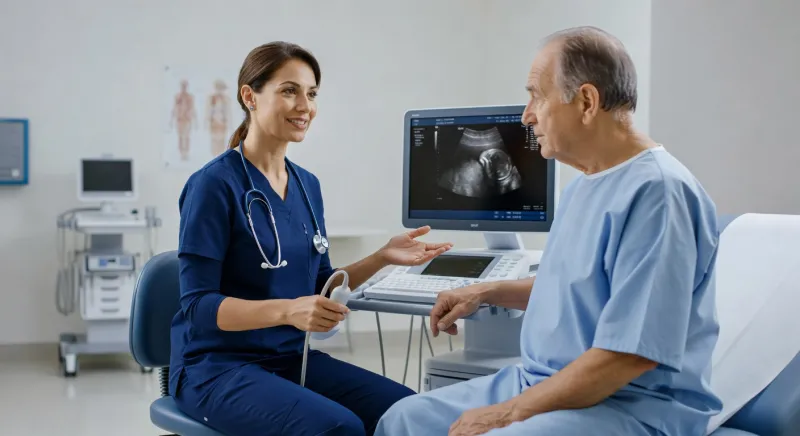
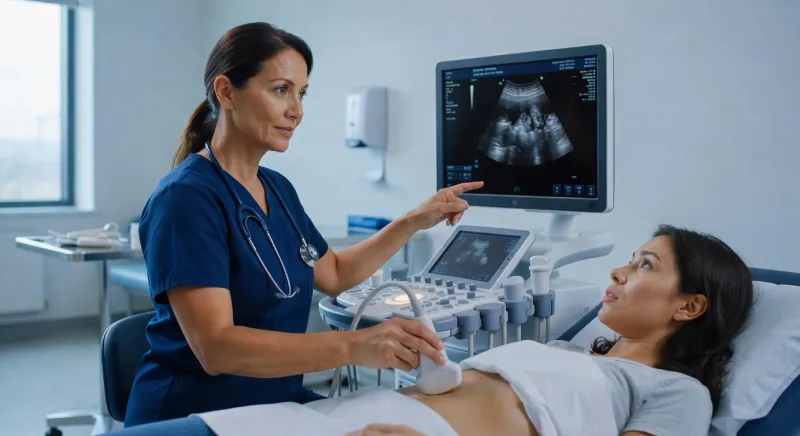
An echocardiogram (often called an "echo") is an ultrasound scan of the heart. It uses sound waves to create real-time moving images of the heart's chambers, valves, and walls as they contract and relax. Unlike a still photograph, an echocardiogram captures a video — typically several seconds of your heart beating through a full cycle. That motion is precisely what makes it so diagnostically valuable, and also what makes it tricky to analyze automatically.
The Number That Matters: Ejection Fraction
Among all the measurements doctors extract from an echocardiogram, one stands out as especially important: ejection fraction. Ejection fraction — the percentage of blood pumped out of the heart per beat — is a key diagnostic metric for heart failure, with a normal range of 55–70%.
Think of the heart's main pumping chamber, the left ventricle, as a balloon. It fills with blood, then squeezes. Ejection fraction tells you what fraction of that blood actually gets pushed out into circulation. A healthy heart ejects more than half its blood with every beat. A weakened heart might eject far less — and that difference has enormous consequences for treatment decisions, prognosis, and even whether someone qualifies for certain medications or devices.
Measuring ejection fraction manually requires a cardiologist to watch the echo video, trace the outline of the left ventricle at its fullest and emptiest points, calculate the volumes, and do the math. It's time-consuming and somewhat subjective — different readers looking at the same video can come up with meaningfully different numbers. That's exactly the problem AI is well-positioned to help solve.
💼 Career Opportunities
How AI Models Analyze Echocardiogram Videos
The AI systems now being applied to echocardiography belong to a category called deep learning — a type of machine learning that uses layered networks of mathematical operations loosely inspired by the brain. For image and video analysis, the most important building block is the convolutional neural network (CNN). A CNN is designed to automatically detect patterns in visual data: edges, shapes, textures, and more complex structures built from those simpler pieces.
Deep learning models for echocardiography use convolutional neural networks applied to video frames to segment the left ventricle and track its volume changes across the cardiac cycle.
Let's unpack what that means in plain terms. "Segmentation" means identifying and outlining a specific region in an image — in this case, the left ventricle. The AI learns to look at each frame of the video and draw a boundary around that chamber, distinguishing it from surrounding tissue, valves, and fluid. Then, by tracking how that outlined region changes in size from frame to frame across the heartbeat cycle, the model can calculate how much the chamber expands when filling and shrinks when pumping. From those volume estimates, ejection fraction follows directly.
Crucially, the AI isn't working from rules someone hand-coded. It learns these patterns from data — specifically, from thousands of echocardiogram videos that cardiologists have already analyzed and labeled.
EchoNet-Dynamic: The Landmark Study
The research that put AI echocardiography on the map for many clinicians came from Stanford. Stanford researchers published a study showing an AI model (EchoNet-Dynamic) could measure left ventricular ejection fraction from echocardiogram videos with accuracy comparable to cardiologists, with results published in Nature in 2020.
EchoNet-Dynamic was trained on over 10,000 annotated echocardiogram videos from Stanford University Medical Center. That's a massive dataset by medical imaging standards. Each video came paired with expert measurements, giving the model a clear target to learn from.
The phrase "accuracy comparable to cardiologists" deserves explanation. When researchers evaluated the AI, they compared it not just against a single expert's measurements, but against the natural variability you see when multiple cardiologists read the same scan. The AI's estimates fell within that human range of disagreement — meaning it performed about as consistently as a trained specialist would. That's a meaningful benchmark, not just a technical curiosity.
From Research Lab to Clinical Practice
A promising research result and a tool doctors actually use are very different things. Regulatory clearance is the bridge. In the United States, the Food and Drug Administration (FDA) evaluates medical devices — and AI diagnostic software counts as a medical device — before they can be used in clinical care.
The FDA has cleared multiple AI-based echocardiography analysis tools, including Caption AI (formerly Caption Health), for clinical use in guiding ultrasound acquisition and interpretation.
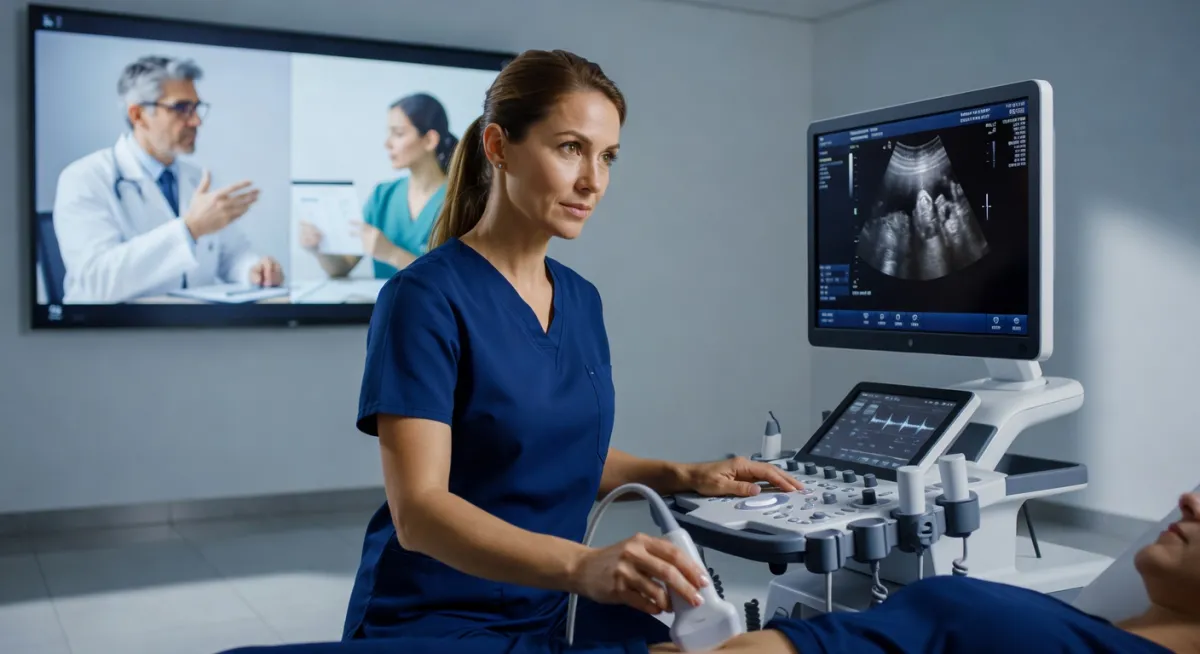
Caption AI represents an interesting application: rather than just analyzing images after they're captured, it helps guide the person holding the ultrasound probe in real time, coaching less experienced operators toward better image quality. This matters because getting a good echocardiogram requires skill. If AI can help a nurse or emergency physician capture usable images, it expands who can perform useful cardiac assessments and where — think rural clinics, urgent care centers, or even bedside in a busy emergency department.
Why This Is Hard (and Why Getting It Right Matters)
Echocardiogram video is genuinely difficult data to work with. Ultrasound images are inherently noisy — sound waves bouncing through tissue produce artifacts, shadows, and blurry boundaries. Different machines, different operators, and different patient body types all introduce variation. The heart itself is constantly moving, and different views (the probe can be placed in different positions to see the heart from different angles) look quite different from one another.
Getting AI to be robustly accurate across this variation — not just on clean research datasets but on the messy diversity of real clinical practice — is an ongoing challenge. Researchers continue working on making these models more reliable across different hospital systems, patient populations, and imaging equipment.
Getting it right matters enormously. Ejection fraction drives treatment decisions. A patient misclassified as having reduced heart function might receive powerful medications with real side effects. One missed might not receive treatment that could improve their quality of life. The stakes are high enough that AI tools in this space are designed to support, not replace, physician judgment.
What This Means for Cardiac Care
The implications of accurate, automated echocardiogram analysis reach in several directions.
Faster, More Consistent Readings
In busy cardiology practices and hospitals, echocardiograms can pile up waiting for specialist review. AI can provide rapid preliminary measurements, flagging urgent findings and helping prioritize. It can also reduce the variability between readers, making measurements more consistent over time and across institutions.
Access in Under-Resourced Settings
Cardiologists are concentrated in urban centers and wealthy regions. AI-assisted echocardiography could extend sophisticated cardiac assessment to places and situations where specialist expertise isn't readily available — smaller hospitals, rural clinics, low-income countries. A tool that can guide image capture and automatically analyze the result could make cardiac screening dramatically more accessible.
Continuous Improvement
Unlike a human expert who learns slowly over a career, AI models can be retrained on new data as more annotated cases become available, potentially improving over time in ways that compound across the entire field rather than individual practitioners.
The Bottom Line
AI echocardiogram analysis is not science fiction or a distant promise. It's real, it's been validated in peer-reviewed research at major medical centers, and tools built on these methods are already cleared for clinical use. The underlying mechanism — convolutional neural networks learning to segment the heart and track its motion across thousands of training videos — is sophisticated but logical once you see the steps. And the potential benefits, from faster readings to broader access to more consistent measurements, address real problems in cardiac care today.
The cardiologist isn't going away. But their ability to help more patients, more efficiently and in more places, is quietly being expanded by algorithms that have learned, one labeled video at a time, to see what a trained eye sees in a beating heart.
Sources
Every factual claim in this article was independently verified against the following sources:
- Video-based AI for beat-to-beat assessment of cardiac function | Nature — nature.com
- Ejection Fraction Heart Failure Measurement | American Heart Association — heart.org
- EchoNet Dynamic — echonet.github.io
- Artificial Intelligence-Enhanced Echocardiography for Systolic Function Assessment - PMC — pmc.ncbi.nlm.nih.gov
- Automatic segmentation of the left ventricle in echocardiographic images using convolutional neural networks - PMC — pmc.ncbi.nlm.nih.gov