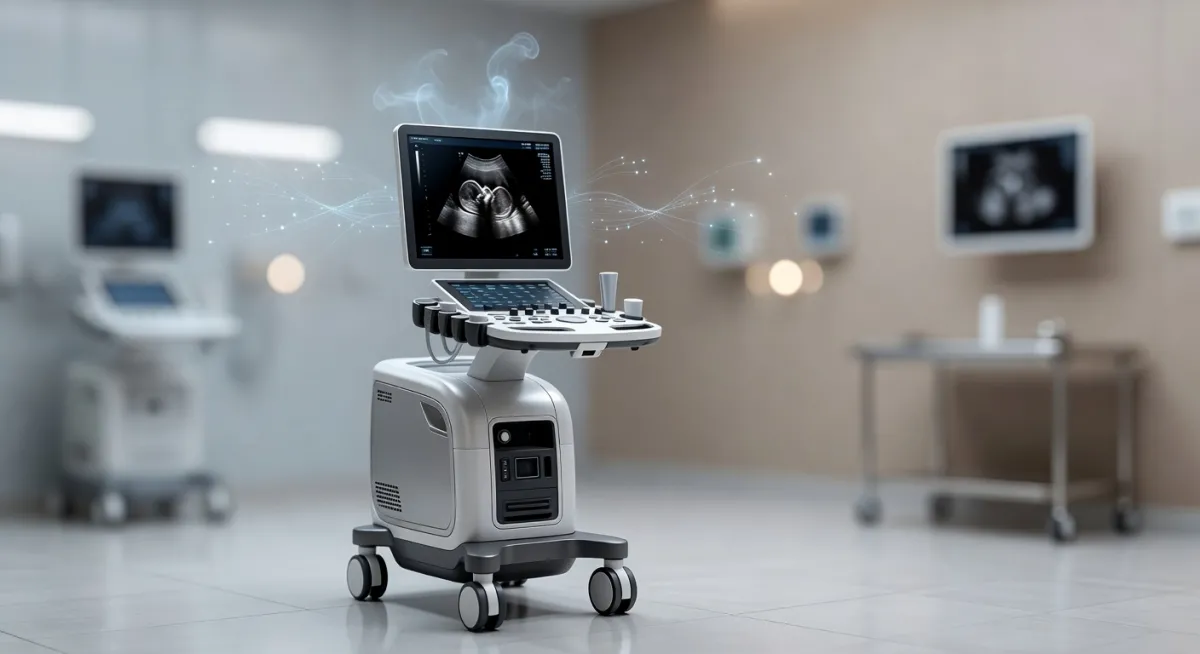
It rarely starts with a bold declaration. No sonographer walks into an exam room intending to practice medicine. Instead, it begins with a glance — a patient's eyes fixed on the monitor, searching your face for any flicker of reassurance — and a completely human impulse to ease their fear. You say something small. Something that seems harmless. And then, scan by scan, shift by shift, the boundary between technical expert and interpreting clinician quietly dissolves.
This is scope creep in diagnostic medical sonography: not a dramatic ethical breach, but a gradual, well-intentioned erosion of one of the profession's most consequential boundaries. Understanding exactly how it happens — and why it happens to skilled, conscientious sonographers — is the only reliable way to stop it.
What Scope of Practice Actually Means for Sonographers
The sonographer's scope of practice is defined by a layered set of authorities: credentialing bodies, professional societies, state regulations, and institutional policy. At its core, it establishes that sonographers acquire images and clinical data; physicians interpret those images and communicate findings to patients. The sonographer's role in the diagnostic chain is irreplaceable and expert — but it is not the final interpretive step.

As an Amazon Associate, I earn from qualifying purchases.
Professional organizations including the Society of Diagnostic Medical Sonography (SDMS) and the American Registry for Diagnostic Medical Sonography (ARDMS) have published position statements and ethical codes that address patient communication explicitly. The SDMS Code of Ethics calls on sonographers to act within their defined scope and to refer patients appropriately when questions arise that exceed that scope. These aren't bureaucratic formalities. They exist because premature or inaccurate disclosures cause documented harm — delayed diagnoses, false reassurance that keeps patients from pursuing follow-up, and legal exposure for both the individual sonographer and their institution.
💼 Career Opportunities
For sonographers navigating workplace rights questions around these obligations, understanding that your scope is simultaneously a protection and a professional standard is essential grounding.
The Anatomy of Scope Creep: How the Drift Actually Happens
Stage One: The Compassionate Impulse
Most scope creep originates in empathy, which makes it particularly difficult to self-police. A patient is visibly distressed. They've been waiting two weeks for this scan. Their referring physician is notoriously poor at follow-up communication. You can see clearly — at least in your trained estimation — that what you're imaging is unremarkable. The temptation to say "everything looks fine" is not unprofessional carelessness. It is a genuine, human desire to relieve suffering.
But "everything looks fine" is a diagnostic conclusion. The moment it leaves your mouth, you have stepped outside your role, regardless of how correct you turn out to be. The problem is not your intention. The problem is that you have no way to guarantee you are correct, and neither your training nor your professional role authorizes you to make that guarantee.
Stage Two: The Normalized Exception
The second stage is normalization. If nothing bad happens the first time — if the patient smiles, thanks you, and the study is indeed normal — the behavior gets internally validated. The exception becomes a habit. Over time, the sonographer who once held a firm line finds themselves routinely characterizing findings, speculating about diagnoses, and filling the silence that patients inevitably create with disclosures that feel conversational but function as clinical communication.
This normalization is accelerated by certain work environments. High-volume outpatient settings, where physicians are rarely physically present, create more opportunity and more patient pressure. Sonographers working in solo or semi-autonomous configurations — including those in outpatient and clinic jobs — may find that the organizational scaffolding supporting appropriate boundaries is thinner than in a hospital department with radiologists down the hall.
Stage Three: The Institutional Vacuum
Scope creep accelerates dramatically when institutional policy is vague, absent, or unenforced. When no one in leadership has clearly articulated what sonographers may and may not say, individual sonographers fill that vacuum with their own judgment — and individual judgment under patient pressure almost always trends toward disclosure. A department without a documented, communicated, and consistently enforced patient communication policy is a department that is systematically producing scope creep, regardless of the intentions of its staff.
Stage Four: The Peer Modeling Effect
Scope creep is also socially transmitted. When a new sonographer enters a department and observes experienced colleagues making casual diagnostic comments to patients, the behavior is absorbed as normative professional practice. Senior staff who engage in scope creep are not just violating their own boundaries — they are training the next generation to violate theirs. This is one of the reasons the problem compounds over time rather than self-correcting.
The Specific Language That Crosses the Line
Scope creep lives in specific words and phrases. Recognizing them — in your own speech and in the speech of colleagues — is a concrete clinical skill. The following categories represent the most common forms of boundary-crossing communication.
Diagnostic Characterizations
Any statement that names, categorizes, or rules out a pathological condition is a diagnostic characterization. This includes:
- "That looks like a cyst, probably nothing to worry about."
- "I don't see any gallstones."
- "Your baby looks perfectly healthy."
- "That shadow isn't anything concerning."
Each of these sounds innocuous. Each of them constitutes a diagnostic conclusion. Note that ruling something out is just as interpretive as ruling it in — telling a patient you don't see gallstones is a diagnostic statement with real clinical consequences if you are wrong or if the study is technically limited.
Predictive or Prognostic Statements
Telling a patient what their results mean for their future care — "you'll probably just need to come back in six months" or "this might need a biopsy" — goes beyond image acquisition into clinical decision-making. Even when these predictions are likely accurate, they are not yours to make.
Hedged Disclosures
Hedging does not neutralize a diagnostic disclosure. "I'm not supposed to say anything, but it looks okay to me" is not safer than a direct statement — it may actually be worse, because it combines a boundary violation with an explicit acknowledgment that the sonographer knows they are out of bounds. Patients register the content, not the hedge.
Non-Verbal Communication as Disclosure
Scope creep is not exclusively verbal. Extended pauses while imaging a specific area, visible changes in facial expression, or the act of calling a colleague in without explanation all communicate to attentive patients that something has been found. While sonographers cannot always control their physiological responses to unexpected findings, awareness of non-verbal leakage is a professional skill that can be developed. Maintaining a consistent, calm demeanor throughout — regardless of findings — is part of the technical standard.
Why "But the Patient Deserves to Know" Is a Trap
The most emotionally compelling argument for scope creep is the patient autonomy argument: patients have a right to their own health information, and withholding what you see from them feels like a power imbalance or even a cruelty. This argument deserves to be taken seriously, because it contains a real moral insight — patient autonomy is a genuine and important value.
But the argument contains a category error. Patient autonomy means patients have a right to accurate, complete, clinician-interpreted information delivered within an appropriate therapeutic relationship. It does not mean patients have a right to receive preliminary technical impressions from the person operating the imaging equipment. A sonographer's real-time visual impression of raw ultrasound data is not the same thing as a physician-interpreted report. These are categorically different products, and conflating them under the banner of "patient rights" does patients a disservice.
In fact, premature disclosure can actively undermine patient autonomy by giving patients information they cannot yet contextualize — leading to anxiety, avoidance, or decisions made on incomplete data. The radiologist or ordering clinician who interprets the study and delivers findings in context is serving patient autonomy more completely than the well-meaning sonographer who offers a quick assessment at the end of the exam.
What You Can Say: A Practical Framework
Maintaining boundaries does not require being cold, dismissive, or robotic with patients. There is a wide range of professional, compassionate communication available within scope. The key is learning to redirect rather than deflect — giving patients something real and useful rather than simply shutting down their questions.
Explain the Process, Not the Findings
Patients often ask about findings because they don't understand the workflow. When a patient asks "did you see anything?" they frequently mean "what happens next?" You can answer the real question without touching the diagnostic one: "Your images will be reviewed by the radiologist, and your doctor will receive the report — typically within [timeframe]. They'll go over everything with you." This is substantive, helpful, and entirely within scope. Resources on explaining the exam to patients provide additional language for these conversations.
Validate the Emotion Without Validating the Worry
"I can see you're anxious about this, and that makes complete sense" is legitimate and human. It acknowledges the patient's experience without making any diagnostic promise about what that experience is warranted by. Emotional validation is not the same as diagnostic reassurance, and learning to offer one without the other is a core patient-communication skill.
Normalize the Unknown
"I acquire the images, and the physician is the one who interprets them — that's actually a built-in quality check, because two sets of trained eyes review every study" reframes the limitation as a feature rather than a wall. It's accurate, it's reassuring in the right sense, and it appropriately positions the sonographer's role.
Set Expectations at the Start
The best time to address the question "will you tell me what you see?" is before it's asked, during your introduction and exam explanation. "I'll be taking images for the radiologist to interpret — I won't be able to share results with you today, but I'll make sure you're comfortable throughout" sets a clear expectation and prevents the end-of-exam pressure point from becoming a crisis of professional boundaries.
Institutional Responsibility: This Isn't Only an Individual Problem
Individual sonographers bear genuine professional responsibility for their communication choices. But treating scope creep purely as an individual failure misses its structural dimensions. Departments that create the conditions for scope creep — by leaving communication policy undefined, by creating workflows that isolate sonographers from interpretive oversight, by failing to support staff when patients push back against appropriate limits — share responsibility for the pattern.
Sonographers who identify scope creep as a departmental norm have a professional obligation to raise it through appropriate channels: quality assurance processes, supervisory conversations, or professional society resources. This is not whistleblowing; it is the kind of quality-focused advocacy that protects patients, protects colleagues, and protects the profession's standing.
For those in leadership positions or aspiring to them, building and enforcing a clear, written patient communication policy is among the highest-leverage actions available for patient safety and staff protection alike.
When Pressure Comes from Physicians and Staff — Not Just Patients
Scope creep is sometimes induced by clinical colleagues rather than patients. An ordering physician who calls the ultrasound suite mid-exam and says "just tell me what you're seeing" is creating pressure to operate outside your defined role. A nurse who asks you to relay findings to a patient because "the doctor is tied up" is asking you to substitute for the interpretive step, not merely the communication step.
These situations require the same principled response as patient-generated pressure, delivered with appropriate professional courtesy: "I'm not in a position to interpret findings — I'll flag for the radiologist that this is urgent and make sure they reach the ordering team as quickly as possible." The pressure in these scenarios can feel greater because it comes from authority figures, but the boundary is identical. Your license and your professional integrity are not subordinate to anyone's convenience.
Recognizing It in Yourself: A Self-Audit
Because scope creep is gradual and often unconscious, periodic self-examination is a practical professional tool. After shifts, particularly demanding ones, consider the following questions honestly:
- Did I characterize any finding — positively or negatively — to a patient today?
- Did I use qualifying language ("it looks like," "I think I see") to soften a disclosure that was still fundamentally diagnostic?
- Did I respond to a patient's non-verbal distress by offering more information than I should have?
- Did I say anything I would be uncomfortable having my medical director or department chief review?
- Did a patient leave with a different understanding of their status than the one their ordering physician currently holds?
A "yes" to any of these questions is not an occasion for self-flagellation. It is an occasion for recalibration. The sonographers most vulnerable to scope creep are often the most skilled and the most empathetic — precisely because they understand more and care more. Recognizing a drift is the beginning of correcting it, not evidence of unfitness.
The Professional Stakes Are Real
Beyond patient safety, scope creep carries concrete professional risk. Depending on jurisdiction and the specifics of a given disclosure, a sonographer who communicates diagnostic impressions to patients may face credentialing consequences, institutional disciplinary action, or civil liability — particularly when a disclosure contributes to demonstrable patient harm. These risks are not theoretical. They have materialized in real cases, and they are asymmetric: the risk is borne almost entirely by the sonographer, not by the patient whose gratitude prompted the comment.
Maintaining clear communication boundaries is not timidity or indifference. It is the exercise of professional discipline in the service of patients, colleagues, and the long-term credibility of a profession that has earned its place in the diagnostic chain through precisely that kind of rigor.
Good sonographers don't drift into scope creep because they are careless. They drift because they are human, because they are skilled, and because the situations that generate scope creep are genuinely difficult. Naming the mechanism — understanding that empathy, normalization, institutional vacuums, and peer modeling combine to gradually move the boundary — is not a reason for cynicism. It is a map. And having a map is how you avoid getting lost.