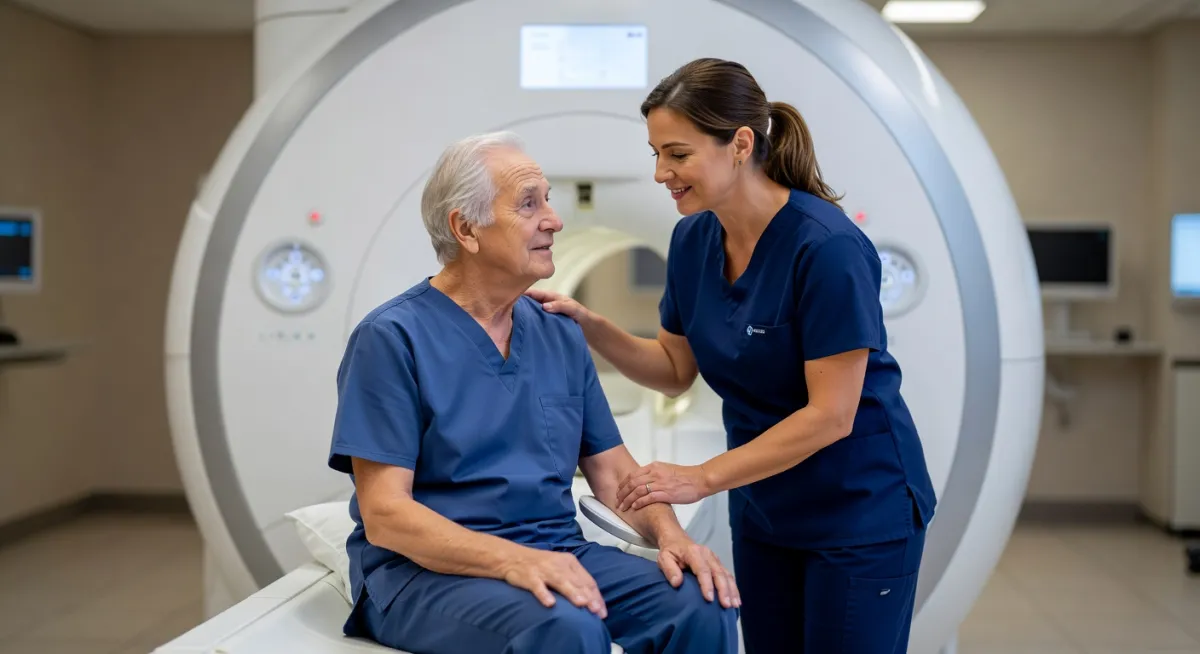
You finish a scan on a patient who spent the entire exam quietly crying, gripping the side of the table, barely able to answer your questions. You document your findings, move to the next room — and notice, somewhere around your third rib, a heaviness that wasn't there an hour ago. You didn't receive bad news. You didn't lose anyone. But something transferred anyway. That's not weakness, oversensitivity, or poor professional boundaries. That's emotional contagion, and it's as neurologically real as a reflex arc.
For sonographers, understanding this phenomenon isn't an academic exercise. You routinely work in intimate physical proximity with patients who are frightened, grieving, or bracing for a diagnosis. You are often present at moments of profound uncertainty — and the scan room, with its dim lighting, close quarters, and enforced stillness, creates near-ideal conditions for emotional states to propagate from one nervous system to another. Knowing the mechanism gives you something better than willpower to work with.
What Emotional Contagion Actually Is
Emotional contagion is the automatic, largely unconscious process by which one person's emotional state is transmitted to and mirrored in another. The term was formalized in the psychological literature in the 1990s, most prominently through the work of Elaine Hatfield and colleagues, who described it as a three-stage process: mimicry of facial expressions and posture, afferent feedback from those physical changes to the brain, and the subsequent subjective experience of the emotion itself. In simpler terms: your body copies what it sees, and your brain interprets those copies as feelings.

As an Amazon Associate, I earn from qualifying purchases.
This is distinct from empathy, though the two are often conflated. Empathy involves a conscious, perspective-taking awareness of another person's emotional state — you understand they are afraid. Emotional contagion is pre-cognitive: you become afraid alongside them before your prefrontal cortex has had time to frame what is happening. The distinction matters clinically, because the management strategies for each are different.
💼 Career Opportunities
The Neural Architecture Underneath
Mirror Neuron Systems
The neurological substrate most frequently cited in discussions of emotional contagion is the mirror neuron system. First characterized in macaque primate research and subsequently inferred in humans through neuroimaging, mirror neurons fire both when an individual performs an action and when they observe the same action performed by another. Researchers extended this framework to emotional states: observing fear, pain, or distress activates overlapping neural regions as actually experiencing those states, particularly in the anterior insula and anterior cingulate cortex — areas deeply involved in interoception and the felt sense of the body's internal condition.
For a sonographer, the relevance is immediate. When your patient's jaw tightens, their breathing shallows, and their hands grip the sheet — your nervous system is running a simulation of that same state. You don't decide to do this. It happens in the background, continuously, at a speed that conscious awareness cannot intercept in real time.
Autonomic Resonance and Co-Regulation
Beyond mirror neuron frameworks, there is substantial evidence that autonomic nervous systems of individuals in close proximity can entrain to one another — a phenomenon sometimes called physiological co-regulation or coregulation. Heart rate variability, cortisol rhythms, and skin conductance can synchronize between people in emotionally charged interactions. In clinical settings, this means a sonographer's stress physiology can genuinely shift in response to a patient's, not metaphorically but measurably.
As an Amazon Associate, we earn from qualifying purchases.
This has particular implications for managing anxious patients — because the relationship runs both directions. A calm, regulated sonographer can actively down-regulate a patient's nervous system through the same contagion mechanisms that otherwise transmit distress. Your tone of voice, your breathing pace, your postural stability: these aren't just bedside manner niceties. They are neurophysiological inputs into your patient's arousal state.
Why Some People Absorb More Than Others
Individual differences in susceptibility to emotional contagion are well-documented. People with higher trait empathy, those who score higher on measures of emotional reactivity, and individuals who have personally experienced trauma related to illness or loss tend to show greater contagion effects. Healthcare workers who entered their professions specifically because of strong interpersonal attunement — which describes a substantial proportion of sonographers — are not randomly distributed in this regard. The very quality that makes you good at this work is the same one that makes you vulnerable to absorbing its emotional weight.
Why the Scan Room Is a High-Contagion Environment
Not all clinical encounters carry the same emotional contagion risk. The ultrasound suite has several characteristics that amplify transmission:
- Physical proximity. You are within arm's length of your patient for extended periods, often with direct skin contact during transducer placement. Close physical distance is consistently associated with stronger emotional contagion effects.
- Reduced environmental stimulation. Dim lighting and relative quiet reduce competing sensory inputs, effectively increasing attentional focus on the patient's emotional cues.
- Diagnostic ambiguity. Patients frequently arrive not knowing what you will find, and they are watching your face for information. That mutual vigilance intensifies the emotional circuit between you.
- Volume and variety of emotional content. A single sonographer shift may include a first-trimester loss, a routine obstetric survey on an anxious first-time parent, a vascular study on a patient with end-stage renal disease, and a pediatric abdominal scan with a terrified child. Each encounter carries its own emotional valence, and the accumulation across a shift is cumulative.
The Problem with the Standard Advice
The conventional institutional response to emotional labor in healthcare tends to collapse into two inadequate poles: "maintain professional distance" on one side, and "practice self-care" (typically meaning eat lunch and perhaps do yoga) on the other. Neither engages meaningfully with the neuroscience.
Advising emotional suppression — the effort to consciously inhibit emotional expression and experience — is counterproductive. Research on emotion regulation consistently shows that suppression increases physiological stress responses even when behavioral expression is reduced. You feel worse, your cognitive performance degrades, and the implicit emotional signal still transmits to your patient, who picks it up as incongruence and often becomes more anxious as a result. Suppression doesn't stop contagion; it just adds a layer of effortful cognitive overhead that depletes you faster.
The goal is not to feel less. The goal is to process more efficiently and recover more completely.
Reappraisal Over Suppression
The emotion regulation strategy with the strongest evidence base for healthcare workers is cognitive reappraisal — changing the meaning you assign to an emotional trigger, rather than trying to suppress the emotion after it has been generated. Reappraisal intervenes earlier in the emotional processing sequence, before the full physiological response has been engaged, and produces substantially lower autonomic arousal and cortisol output compared to suppression.
In practical terms for the scan room: when you feel that rising tightness while scanning a patient in visible distress, the question is not how do I turn this off? but how do I understand what is happening? A reappraisal frame might be: I'm noticing that I'm picking up this patient's fear, which means I'm appropriately attuned to them. That attunement is part of what I bring to this work. I can hold this with them without taking it home.
This is not positive thinking in the facile sense. It is deliberately engaging your prefrontal cortex in the regulation process rather than trying to white-knuckle your way through raw suppression.
Concrete Strategies Grounded in the Mechanism
Intentional Physiological Anchoring Before and Between Scans
Because autonomic entrainment is bidirectional, deliberately regulating your own nervous system before entering the scan room gives you a more stable baseline. Extended exhalation — breathing out for longer than you breathe in — activates the vagal brake and increases heart rate variability, measurably shifting your autonomic state toward parasympathetic dominance within a few cycles. This takes ninety seconds. It is not meditation; it is a physiological lever. Sonographers who develop the habit of a brief transition ritual between patients — even thirty seconds of slow breathing in the hallway — create a neurological reset that reduces carryover from the previous encounter.
Labeling, Not Suppressing
Neuroscientific research on affect labeling — putting emotional experiences into words — shows that naming an emotion reduces amygdala activation and increases prefrontal regulation. This can be as simple as a private, internal acknowledgment: I'm feeling some of their grief right now. The act of labeling creates a slight observational distance from the raw emotional state without suppressing it. Over time, this becomes automatic and requires minimal cognitive effort.
Deliberate Posture and Vocal Tone Calibration
Since emotional contagion is in part driven by afferent feedback from your own body, your posture and voice are not just outputs — they feed back into your own emotional experience. Deliberately adopting an upright, stable posture (not rigid, but grounded) and a measured vocal pace signals your own nervous system toward regulation. This is the basis of the practical clinical observation that experienced sonographers who seem effortlessly calm in difficult scans are often doing something physiologically intentional, not simply feeling nothing.
Debriefing as Neural Hygiene
Emotionally significant encounters that are not processed tend to accumulate. Brief verbal debriefing with a trusted colleague — not clinical discussion of findings, but acknowledgment of the emotional content of a difficult scan — activates the same prefrontal-mediated processing that reduces rumination and intrusive recall. Departments that normalize this kind of brief peer processing after particularly difficult studies have lower rates of secondary traumatic stress. This is a structural intervention, not an individual coping strategy alone, and it is worth advocating for within your department culture.
Recognizing Secondary Traumatic Stress as Distinct from Burnout
Emotional contagion that is chronically unprocessed can develop into secondary traumatic stress (STS) — a constellation of symptoms that resembles PTSD and includes intrusive imagery, hyperarousal, emotional numbing, and avoidance. STS is distinct from burnout, though they frequently co-occur. Burnout is characterized by exhaustion and depersonalization developing through cumulative job demands; STS is specifically linked to exposure to others' traumatic material. The distinction matters because the interventions differ. Burnout responds to workload and role adjustments; STS typically requires more targeted trauma-informed support.
If you notice that you are replaying a patient's distress at home, having difficulty shaking images from a difficult case, or finding that you are blunting your own emotional responses as a protective measure, these are STS indicators worth taking seriously — and worth distinguishing from general occupational fatigue.
Preserving Empathy While Managing Contagion
The risk of knowing all of this is that practitioners sometimes swing toward emotional detachment as a protection strategy. The evidence suggests this is both personally costly and clinically suboptimal. Patients are exquisitely sensitive to whether their clinician is genuinely present with them or performing presence from behind a professional wall, and perceived warmth affects patient-reported experience, cooperation during the exam, and even physiological measures of patient anxiety during procedures.
The target state is what researchers sometimes call empathic concern — the capacity to be genuinely moved by a patient's situation while remaining a differentiated, regulated presence. This is not a fixed trait. It is a skill that can be developed, and the neuroscience of emotion regulation provides its underlying mechanism. You are not trying to feel nothing; you are trying to feel, process, and return to baseline with enough speed and completeness that the next patient gets your full attention and the feelings from the previous encounter don't compound into something unmanageable by the end of the week.
A Note on High-Volume and High-Acuity Settings
The structural context matters significantly. Sonographers working in high-volume environments with minimal time between patients, limited peer support, and high diagnostic acuity face a considerably higher emotional contagion burden than the individual-level strategies above can fully address. Individual regulation skills are necessary but not sufficient. The evidence on healthcare worker wellbeing consistently points to organizational factors — staffing ratios, schedule design, access to psychological support, peer debriefing norms — as primary determinants of long-term practitioner resilience.
If your practice environment is structured in ways that make these strategies difficult to implement — no transition time between patients, no psychological safety for peer processing, chronic understaffing — that is a systemic problem that individual mindfulness cannot solve. Recognizing the limits of individual-level intervention is itself a form of accurate self-appraisal, not resignation.
What This Actually Looks Like in Practice
The sonographer who manages emotional contagion well is not the one who feels least. They are typically the practitioner who has developed a kind of granular, ongoing self-awareness — noticing their own state in real time, making small regulatory adjustments continuously rather than waiting for exhaustion to accumulate, and processing emotional material in brief doses rather than banking it all for a weekend that never quite delivers recovery. They are often described by colleagues as calm, present, and genuinely warm — not because they are emotionally uncomplicated people, but because they have developed the capacity to be moved without being swept away.
That is a learnable skill. The neuroscience of emotional contagion in healthcare workers doesn't just explain why this job is hard. It points, fairly precisely, at the mechanisms you can work with to make it sustainable — without becoming someone who stopped caring.